Depth of Processing Depth of Processing Depth of Processing Depth of Processing: Movies Depth of Processing: Food and Wine Depth of Processing: Food and Wine Depth of Processing Depth of Processing

Thursday, February 12, 2009

Nanofibers Hold Microscopic Ball


Behold this remarkable photo of a 10 micron long epoxy fibers (0.15 micron apart from each other), holding a 2.5 micron polystyrene sphere. The entire assembly was immersed in water, and as the water is withdrawn, the capillary forces caused the fibers to grab the ball and hold it.

This is from Harvard's Aizenberg, and it was published in 9 January's Science Magazine (323 p237ff). The article is light on experimental details and long on bio-mimetic jibberish. The image is great to look at, but don't forget that it is an SEM, and some artist at C&E News added the blue color to the ball.

I think it is interesting that they were able to make these structures, and even more interesting to think about how much the adhesion of the surface is enhanced by having these threadlike structures. It would be great to be able to make practical materials with these little filaments on them. There would be many practical uses.

Sunday, February 8, 2009

Rotating Illusion


This strangely realistic illusion of turning wheels is nothing I have seen before. It is from Akiyoshi Kitaoka in 2003. He wrote a scholarly paper on it. The paper talks about stepwise changes in luminance in one's peripheral vision, and this causes a "drift illusion."

!!--Check out my September 13, 2009 post for two more optical illusions.--!!

Sunday, February 1, 2009

2009 Garden

Looking forward to Spring is one of the best parts of Winter.

The garden for 2009 is planned out. Of course, does the real garden ever look like the plan?

My flower garden in Michigan is far smaller than the ones in Wisconsin or Minnesota. It is a lot of work, and the previous owner left me flowerbeds where no one can see them. I need to see the flowers every day if I am going to maintain enthusiasm for it. Anyway. Flowers are going to be Impatiens and Profusion Zinnias --yes just two varieties. I need to order seeds today. I know that I could buy Impatiens as nice as I could grow, but it is still fun to grow them. I think my north flower border is too sunny for impatiens, so its Profusions this year.


I really wanted to replace the impatiens totally with some perennial groundcover this year, but my wife has a right-brain attachment to flowers lining each side of the walk. This would be OK if she wanted to help grow it.


In the vegetable garden the big story is the strawberries, which are now in their third year are thriving and taking up more space. I will enlarge the garden going north to make a little more room. I have big hopes for the strawberry crop this year.

There are five tomatoes:

Sun Sugar - about the sweetest and tastiest cherry tomato you could want.

Yellow Pear - never grew it before, but it had good reviews


Black Cherry - Which is a trendy purply cherry tomato. Jenny got some at Whole Foods. Maybe these seeds will taste the same.

Burpee Supersteak Hybrid - against my better judgement, beefsteak tomatoes seem prone to disease and slow ripening. Still the one or two that you get are nice.

Burpee Best Boy - A nice looking tomato, but it is determinant -- meaning that all the tomatoes ripen at the same time. Why would a home gardener want that?


Calliope Hybrid Eggplant - I have been eating more eggplant, and this was a nice variety from last year.


Another favorite is my Pineapple Tomatillo. These cherry size tomatillos are sweeter than standard ones and have a fruity taste. They are about the messiest vegetable ever, and the squirrels got well over half of them last year. I'll take a better picture of them too --the photos online are not so good.


Pimento is back this year after a decade on hiatus. I am tired of growing hot peppers that are too hot to eat. Pimento is nice and fleshy and not hot at all. I also get a better yield of red fruit than bell peppers. I don't like bell peppers anyway. Last year's Italian peppers were failures.

There are also cucumbers, spinach, arugala, zucchini.

Green peas are on the bubble. They take up lots of space, and the rabbits love them. If it were possible to buy fresh peas, I would never grow them. Maybe just a few plants.

Gone this year are the true peppers, basil (I never really liked pesto), kale (Did I eat it once last year?)  I am hoping to get Jenny to do the potted flowers on the deck. I have lost interest in those.

In the fall, I expected a much smaller garden, but then I get over-enthusiastic every Spring.


==========================================================


See the update post on how this garden turned out. 

Saturday, January 17, 2009

On the Mythical Properties of Coconut Oil

My dear wife has the book, Eat Fat, Lose Fat, by nutritionist Mary Eng and Sally Fallon. This book advocates oil-centric diets with scientific-seeming arguments about the benefits of coconut oil. It reads like faddish pseudoscience to me, although I think it is well established that Atkin's like high fat diets do lead to weight loss -- although at the expense other negative health effects.

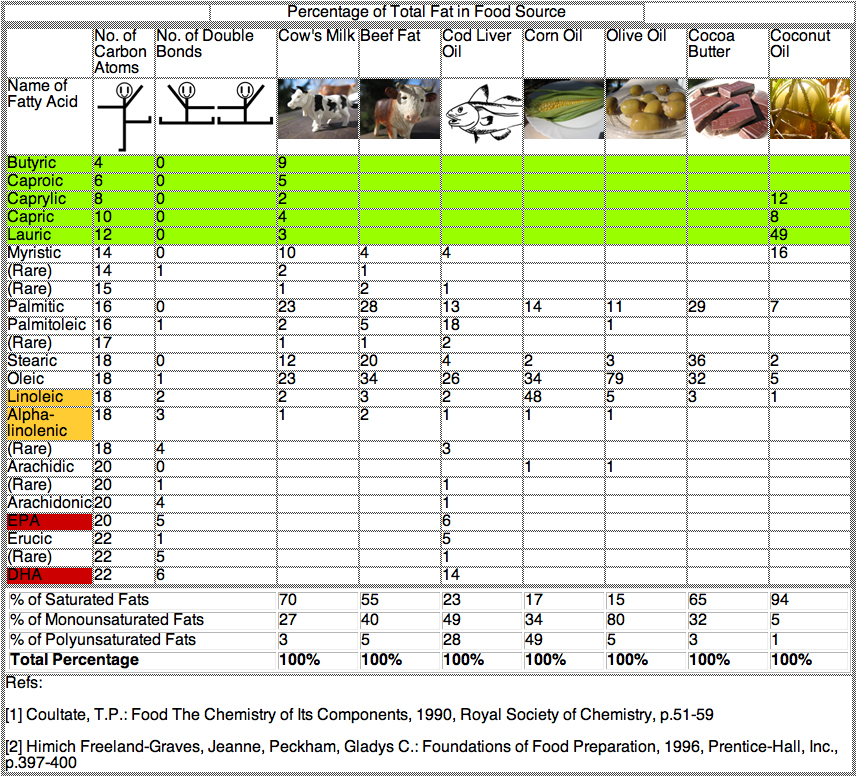
Coconut oil, while a saturated fat, is made from shorter chain fatty acids, and it is more easily metabolized by the liver than longer fatty acids, most especially palmitic or oleic.

I think that the widespread negative opinion of coconut oil was informed by data like the fatty acid source table at the bottom of this post. That table that lumped all saturated acids shorter than C-16 together. That table certainly makes coconut oil seem awful. Learning that there are more medium length oils reopens the topic.

There is a very sensible article on coconut oil by Craig Hassel on the University of Minnesota website. He addresses the coconut oil fad, and concludes that it is not as bad as people thought a decade ago. While coconut oil contains 60% medium fatty acids of C-12 or less, it also contains 40% palmitic and myristic acids which are known to increase blood cholesterol. His point about the health effect of coconut oil, that it depends the other food which coconut oil displaced in the diet. If one replaces butterfat with coconut oil, great. If one replaces olive oil, then the effect on cholesterol will be negative.

This conclusion avoids the discussion of the secondary medical benefits of the acids, most specifically caprylic and lauric. I need to read up on that further. Caprylic is only present at 12% though. My intuition is that caprylic acid may be more medicinal than other fatty acids, and that it should be used with care: in controlled amounts.


Source:

Table of Fatty Acids
Acid
Name
Structure
Melt
Point
Graphic Chime
SATURATED
Lauric CH3(CH2)10COOH
+44
Graphic Chime
Palmitic CH3(CH2)14COOH
+63
. Chime
Stearic CH3(CH2)16COOH
+70
Graphic Chime
UNSATURATED
Oleic CH3(CH2)7CH=CH(CH2)7COOH
+16
Graphic Chime
Linoleic CH3(CH2)4(CH=CHCH2)2(CH2)6COOH
-5
Graphic Chime
Linolenic CH3CH2(CH=CHCH2)3(CH2)6COOH
-11

Chime
Arachi-
donic
CH3(CH2)4(CH=CHCH2)4(CH2)2COOH
-50
Graphic Chime

Data from: http://www.elmhurst.edu/~chm/vchembook/551fattyacids.html

Below is an even better table:


.
fatty acid percentage in oil
Seeds
Polyunsaturated
Monounsaturated
Saturated
Name
Fat Content in seed

(%)

LNA

18:3w3

(%)

LA

18:2w6

(%)

LNA+LA

w3+w6

(%)

18:1w9

(%)

18:0

(%)

16:0

(%)

Total

(%)

hemp
35
20
60*
80
12
2
6
8
chia
30
30
40
70
-
-
-
-
kukui
30
29
40
69
-
-
-
-
flax
35
58
14
72
19
4
5
9
pumpkin
46.7
0-15
42-57
57
34
0
9
9
soybean
17.7
7
50
57
26
6
9
15
walnut
60
5
51
56
28
5
11
16
wheat germ
10.9
5
50
55
25
18
0
18
evening primrose
17
-
81**
81
11
2
6
8
safflower
59.5
-
75
75
13
12
-
12
sunflower
47.3
-
65
65
23
12
-
12
grape
20
-
71
71
17
12
-
12
corn
4
-
59
59
24
17
-
17
sesame
49.1
-
45
45
42
13
-
13
rice bran
10
1
35
36
48
17
-
17
cottonseed
40
-
50
50
21
25
-
25
rape(canola)
30
7
30
37
54***
7
-
7
peanut
47.5
-
29
29
47
18
-
18
almond
54.2
-
17
17
78
5
-
5
olive
20
-
8
8
75
16
-
16
avocado
12
-
10
10
70
20
-
20
coconut
35.3
-
3
3
6
0
91
91
palm kernel
35.3
-
2
2
13
0
85
85
beech
50
-
32
32
54
8
-
8
brazil
66.9
-
24
24
48
24
-
24
pecan
71.2
-
20
20
63
7
-
7
pistachio
53.7
-
19
19
65
9
-
9
hickory
68.7
-
17
17
68
9
-
9
filbert
62.4
-
16
16
54
5
-
5
macadamia
71.6
-
10
10
71
12
-
12
cashew
41.7
-
6
6
70
18
-
18
neem
40
1
20
21
41
20
-
20


* Includes up to 2% GLA - Gamma Linolenic Acid

** Includes 9% GLA

*** Includes up to 5%erucic acid


* Includes up to 2% GLA -
Gamma Linolenic Acid

** Includes 9% GLA

*** Includes up to 5%erucic acid


Sunday, January 11, 2009

Clean Coal Technology

It is easy to confuse the publicity with the reality. There is no clean coal plant today, but one could be built. Syngas made from coal would be far cleaner than simply burning coal, and there would be no fly-ash. (Actually there are a few plants --see this later post for clarification.)

I was annoyed to see "Exposing the Myth of Clean Coal Technology" on Time.com today. Bryan Walsh, the author, seemed to confuse the actual clean coal technology with putting scrubbers on a conventional plant.

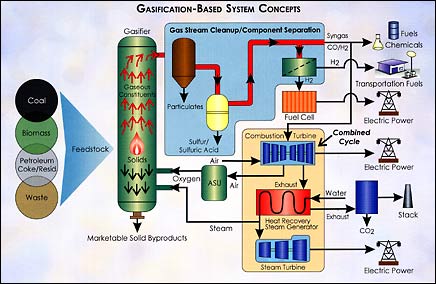
Syngas made from coal, or coal gasification plants would make power as clean as we have a desire to make it. It would provide an easy way to separate carbon dioxide -- although someone has to solve the problem of where to put the enormous amounts of carbon dioxide involved. The diagram below, which is far too complex, shows the process. One can take any carbohydrate feedstock, bake it at high temperature without oxygen, and gasify it. One can burn the resulting gas like natural gas, or one can separate out the carbon dioxide first. One could also separate out all the hydrogen, and use it to make electricity in a fuel cell.

You can find more information on gasification on the DOE website. Although there is one gapping error on the site: they claim there are commercial plants, and there simply are not commercial plants for power production. There are some much smaller plants owned by Sasol in South Africa and some owned by Eastman Chemical in Tennessee. There were also power plants during World War II, and in South Africa during its embargos, but there is no production for power today.


The advantage of gasification of coal is that the carbon dioxide could be separated prior to burning the fuel. Once coal is gasified, it is a better fuel than natural gas.

There are many problems with coal gasification, but it is the real clean coal technology -- not putting scrubbers on a coal burning plant. The chief problem is a large-scale plant built so we can assess the technology. Someone needs to build the first one.

Saturday, January 10, 2009

iPod Touch in a Prius

As the snow gets deeper in Southgate, I decided to make my iPod Touch play in my car, which is a 2006 Prius. The iPod touch uses the same plug interface as the older iPods. I had hooked it up using a box from Dice Electronics


The older Dice Model that I had did not work correctly with the iPod Touch. More specifically you had to reset switches on the case to disable the higher functionality. Before the Prius could control the iPod, but now it cannot.

A fellow named Chris Dragon wrote a nice illustrated installation guide. I used this on my three hour trek to open up the dash and close it up again.

This went pretty well despite the low temperatures in the garage. None of these adventures goes according to plan. A one point I had the whole dash buttoned up, and I plugged the iPod in and it did NOT work. Well, it only took thirty minutes to getting running. I suppose I am getting better at it.

Having said that, there is a crazy video of someone disassembling a Prius Dashboard in FIVE minutes. This guy is pretty speedy. The Prius seems to be designed more for speedy assembly than for speedy disassembly in my eye.

Friday, January 2, 2009

21% Poorer


I spent New Year's Day 2009 figuring out that I am 21% poorer than I was on New Year's Day in 2008.

This depressing fact is actually better than focusing on the magnitude of my 401k decrease, 42%.

It is nice that my house only went down 17% in value. Ironically it is keeping the value of my portfolio up. :-(

I find little comfort from commentators like William Bernstein that I have just as much stock as I did before. If I don't sell, it what difference does it make what the value of it is? That is not the point. I could have done better. Eeek! what if next year is as bad as this one?

I still think that a well diversified portfolio is the way to go, coupled with rebalancing. Right now rebalancing says to perversely sell bonds to buy stock -- especially foreign stock. That is hard to do, but that is where the gains will be on the rebound.

And I am expecting, or is that just hoping, for a rebound.

It is nice to see that the January 2 market results are up. We can always hope for better in 2009. There does not seem to be any news driving it, but what Adam Smith called the "Animal Spirits" of the investors ( and/or savers, speculators and ponzi scheme operators.)

Sunday, December 21, 2008

The Long Lead Time of Innovation

Bill Bixton of Business Week (himself discussing a monograph by Chris Anderson) discussed the notion that it takes a long time for an idea to catch on and be successful.

This seems to be obvious to some, but equally obvious counter examples are easy to find, like the iPhone or Tickle-Me Elmo. How about The Dark Night Batman movie? Prozec?

On the other hand, in the chemical industry it is taking longer and longer to make a break-though mass market innovation. The long induction time of Kevlar comes to mind, and it is still a specialty. It has taken over ten years for polylactic acid PLA to get to the minor share of the polyester market it has today -- is it even 1%.

In my division of BASF we joke about business forecasts with huge volume upswings, and we call them "Hockey Sticks" because of their shape. More often than not the huge growth does not materialize, and people debate on whose fault that was.

The time was when a new polymer or even a new molecule could storm the world. In Pharma I think that is still true today, but blockbuster drugs are getting rarer and rarer. Once something gets regulatory approval, we can see a fast ramp up, often even faster when the patent goes off.

In basic chemicals, the pace of innovation has slowed. I think because the state of knowledge has advanced over the last century, and the basic, generic product is less inferior to the new version. I understand that a new top 50 chemical has not been introduced since the sixties.

On the other hand, there could be new chemicals ripe for commercialization if we had the creativity to realize it. There could be a whopper, but we just don't know. Another Post-it or Velcro.

This reminds me of Clayton Christianson's Disruptive Technology, which might be the subject of another post. He claims that incremental innovation can never give "hockey stick" growth, only new, generally low cost innovations.

Lung Cancer

Lung Cancer can strike with deadly force, and when it strikes it kills over 60% of the time. It has the potential to take one from happy and oblivious to near death fast. Lung cancer kills 31% of all those who die of cancer. The chance of an American getting lung/bronchus cancer before the age of 60 is 1:92 -- surprisingly high. The chance between birth and death is a whooping 1:12. Link

The chance of getting all forms of cancer between birth and death is 50:50.


There were 160,000 deaths due to lung cancer in 2007, and about 2000 in Michigan. The greatest incidence of lung cancer is in Arkansas, and the lowest in Utah. Of course, smoking is the biggest factor in cancer incidence. Lung cancer is most common in African American men; least common in Asian & Hispanic women.

Lung cancer like fatal car accidents and other serious illnesses underscores the fragility of life -- something we all know, but don't think about.

Nassim Taleb in Fooled by Randomness discusses his version of the alternate world hypothesis where chance events take place differently. He says the value of a life is the average of all the possible worlds. Taleb is primarily talking about high finance, but I think the notion applies to disease survivors and victims as well.

Sunday, December 14, 2008

The Christmas Tree


Every year I put up a Christmas Tree, for whatever reason, I always do this instead of my wife. After twenty years of discussion with her, I bought an artificial tree. She always complained about the needles in the living room, and thought that it was environmentally bad to get a natural tree. I never believed that natural trees were harmful, since they are a renewable resource, but I got worn down. I also hated driving the old tree to the dump.

The tree that I bought was a "9' GE Just Cut Aspin Tree," which appears to be made by GE, but is actually sold by a company called Santa's Best Craft in Wisconsin. I suspect the tree was made in China, but it did not say so in the packaging. "Santa's Best" is an actual brick and mortar company in Manitowoc (Wisconsin). The tree is made of PVC, and seems to be dioctyl phthalate-free. It has flexible molded PVC tips and less expensive PVC roll-stock garland branches inside. The PVC is not flammable, so it is safer than a natural tree. Since I used to work in phthalate-free plasticizers, I am interested in what plasticizer they are using, probably something like trioctyl trimellitate, but I'm guessing.

I bought the tree at Lowes, and it was on sale Thanksgiving weekend. The following weekend, Lowes had their whole Christmas stock on half-off -- a new example of rushing the season. I got it on sale. I was thinking about deflation while I was buying it -- if I would have waited another weekend I would have saved more.

After I put the tree up, I did not like it. The tree seemed too even and perfect. When I am right up next to it, it looks artificial. The new tree looks better from across the room than close up.