Depth of Processing Depth of Processing Depth of Processing Depth of Processing: Movies Depth of Processing: Food and Wine Depth of Processing: Food and Wine Depth of Processing Depth of Processing

Saturday, November 6, 2010

Microsoft Office: Mac 2011 Review -- A Huge Improvement

Office: Mac 2011 is the product that Office: Mac 2008 should have been. I ranted about how bad Excel 2008 was.  Office 2008 was a light version of Office that was not worthy of the name or the price. Office 2011 for Mac is what I expect the premium and market leading software to be. Office is expensive, but it suppose to work well, and have all the features.

Excel 2011 has Visual Basic Macros back!!   This is the biggest news to me, though I know most people don't care. I kept trying to find other spreadsheet software that ran macros, before I gave up, and tried to learn Applescript. The macros are back in Word too.

I found my old Macros from Excel 2002 and reinstalled them, and they all run.

The second biggest change in Office 2011 is a better, expanded Ribbon, which is a second enhanced button bar or toolbar. The Ribbon displays different buttons based on context. The Ribbon is easier to use than my customized tool bars that I use at work in Office 2003. Microsoft has moved many of the important commands into buttons. They took away the formatting palette which served many of the same functions as the Ribbon. The palette made Office feel more like an Adobe product.

I am stressed that the Analysis Toolpack is not available in 2011 as it was not in Excel 2008. Instead there is a third party app called AnalystSoft. This is a problem in that the aforementioned macros can't call a regression routine for example, but maybe not too serious. Of course, AnalystSoft is trying to get people to buy the upgrade to AnalystSoft Pro. I promise that I will put a review up after I get a chance to play with it. Ownership of AnalystSoft is unclear.

Pivot tables continue to work real well, and now have an improved Pivot Table Builder.

The chart editing is easier with easier connections to the data. Chart editing in Excel:Mac 2008 was cumbersome and buggy.

Powerpoint feels much the same as the old version. The Ribbon being the biggest change that I notice. There are more objects to insert, and many have been upgraded -- for example the org chart app is easier and more flexible.

All versions of Powerpoint handle tables more poorly than Excel or Word because they are graphics. In the 2011 version, there are more canned table formats that helps to address this problem. I will probably continue to paste Word tables into Powerpoint though.

I used Word to make some labels, and it behaves as expected. The Ribbon being the most observable change.

I found a bug in Word and Excel: the keyboard shortcut to Paste-Special does not work in either application. So that is a little annoying. There was no keyboard shortcut for Paste-Special in Excel:Mac 2008 at all.

Microsoft is also offering service on Windows Live, and one can edit documents with the web-app, and then edit them with the desktop version, and vice versa -- though I suppose there are limits to that.

Overall, I am very pleased with Office:Mac 2011. It is a welcome experience after spending three tough years with Office:Mac 2008.

See the follow-up post on Excel Macros.

Thursday, November 4, 2010

Does Giving Blood Make Me Tired When I Exercise?

I like to give blood because it feels good, and because I can lose a pound of body weight in about fifteen minutes.

I have been worried that giving blood makes me tired sooner so I can't exercise as hard.

There have been a number of studies on this question. One by Birnbaum et al at College of St Scholastica showed that oxygen absorbed decreased by 10% the day after blood donation.

Another article shows 9%. In this article, an exercise that would tire college students in 11 minutes, now tires them in 10.1 minutes. So this means at the end your workout, you are going to feel tired for those last few minutes.

How long does this decrease in performance last? Strangely, it seems to last a long time1.  In women, half of subjects did not recover their original blood iron content in four weeks, however most recovered faster when given megadoses of iron. In men, recover took between 20 and 59 days, with the average being 36 days. That is, the effect of blood donation endures for sometime, and be sure to take iron pills. The effect of gender seems hard to measure. Presumably menstruating women who are prone to low iron, have an especially difficult time recovering from blood donation. 3

A related topic is blood doping, which is transfusing oneself with extra red blood cells so that the blood carries extra oxygen, and presumably this reduces fatigue. There is not good evidence that this actually works because the body removes the extra blood cells quickly. More specifically, capillary pressure removes liquid from the blood increasing its viscosity. Total blood volume equalizes within an hour or so, and blood viscosity rises. There is also a problem with maintaining the stored blood in prime condition.

The same article talks about natural adaptations of endurance athletes, and these include relatively higher blood volume especially plasma volume, so that iron concentration is actually relatively lower. On the other hand blood viscosity is lower, and this improves heart stroke volume, and oxygen transfer. Faster blood flow also aids cooling of the body.

All this is going to slow me down in donating blood. And if I do, I am going to double up on the iron pills.

Sunday, October 31, 2010

Images of Jesus 2


The Jesus Photo
This image is said to be compiled from study of the Shroud of Turin and according to the story  Sai Baba in India blessed a paper copy, and manifested it as a color glossy photo of Jesus.

More likely it is a photo of a painting by Paul Tebay based on a 1931 photograph of the shroud by Guiseppe Enrie. The link to the 1931 photo is based on the shadows and the fold.

I still like the feeling the photo invokes.


Jesus the Redeemer or Christo Redemptor
I love the 130 foot tall, 635 ton concrete statue on Corcovado mountain near Rio de Janeiro Brazil.  It was completed in 1931.

It is cool because it is just, plain big.

The statue over the city evokes the idea of God watching over the world.


Stained Glass Window in side a tomb in Green Wood Cemetery  - New York City (Brooklyn)

I have always liked stain-glass. The intensity of color can't be duplicated in other media.

I like this window because of the expression on Jesus' face. Most stained glass Christs have less evocative faces. This is more of a painting on glass.


Cubist Jesus by Jerry Bacik

I like the mystery and the action of this painting. Sometimes less realism is better.


See also Bacik's blog.


Robert Powell in Jesus of Nazareth


Of all the live actor images of Jesus, I like this one.

Yes I know it is a-historical in that we have a green-eyed European, but I still like it.   A BBC program did a sketch of a historically accurate male from Roman Palestine, and he has a big nose, round eyes, and short hair.

One gets a lot of feeling from the frayed hood, and the hollows below his eyes.

I never liked the Jesus of Nazareth movie because of its slow, slow pacing. I liked the visuals though.


Crucifix
This is an image of Jesus that I grew up with. Not literally, I wish I had a photo from my childhood church in Wisconsin.

It may not be in vogue today, but it has a lot emotional impact.

It is affecting on many levels.


See the previous post, Images of Jesus 1

Saturday, October 30, 2010

Why Not Polish Your Glasses with Paper Towels?

I just got a new pair of glass. Yes, they are highly fashionable -- probably too fashionable for me. The tech at the optician's said, "Never clean them with paper tissue." So why?

Paper tissue is made form trees; trees are made of cellulose. But wait, soft cloths are made from cotton which is made of cellulose too. What is the difference?   I know that a toothpick could not scratch a drinking glass; it just does NOT seem possible that cellulose could scratch glass.

Well there are two factors, first my lenses are polycarbonate, which is much softer than regular lens glass, and second, lens glass is softer than a drinking glass.

Second and more important is that paper is not what it seems. Paper is routinely filled with minerals to make it cheaper -- maybe a little stronger and whiter, but mostly cheaper. So you think you are wiping pure cellulose on your lens, but no!  It's really talc, and clay and titanium dioxide and other cheap filler that the paper maker dumped in. Also wood pulp isn't all cellulose these days either: sometimes there is ground bark which has lignin, sand and the mysterious "foreign matter".

There seems to be a lot of controversy about using Windex to clean glasses. It seems people are worried about Windex washing the coating off of glasses. This is crazy. Windex is about the weakest detergent that there is. It is pretty watery. If a lens maker is using a coating that washes off in Windex -- you have big trouble. No reputable maker would do that. Anti-Windex hype is probably from competitive cleaning solution makers. I don't believe that Windex is a problem.

The cleaning-cloth that people talk about is "microfiber."  Microfiber is finely spun synthetic polyester or polyester nylon blend. (Other polymers are used in engineering applications.) The fibers are 10 microns or less by definition It is quite small as the figure shows. It is used because it weaves into a thin fabric with good conformability. Almost all of it is used for garments including so-called ultra-suede, but also in underwear.  In cleaning, a thin fiber would make finer scratches if it did scratch your lens, it is safer.


Some fibers are made from mixed polymers split after drawing, and split fibers can be 2 microns. As you can see in the picture at left, some splitting is incomplete. I assume the nylon is in the center and the polyester is on the outside. The differential shrinkage causes some splitting, and that gives more surface area for wiping, but only a little more since the splitting is imperfect.


I read a camera site's discussion on lens cleaning and they were all over the map. Some always use microfiber, and some claims it scratches lens. Some use T-shirts and some never do. Some use lens paper, and some only tear the lens paper and use the torn edges. Lens cleaning seems like more of a superstition than a craft.

In summary, I am going to stop using regular tissue and paper towel, and buy some lens paper. I am going to continue to use Windex.

Friday, October 29, 2010

Don't Try to Change the Battery on your Oral-B Toothbrush

Most times home repair projects work great, right? Usually a couple hours of work is rewarded a sense of accomplishment accompanied by monetary savings.  Sometimes not.

I had an Oral-B electric toothbrush which as actually made by Braun. It was a Professional Series 8000 model, which is blue with a white insert.

The battery stopped taking a charge, and so I bought a battery on line at Ebay from Integribiz, who sent me a battery for $15.99.

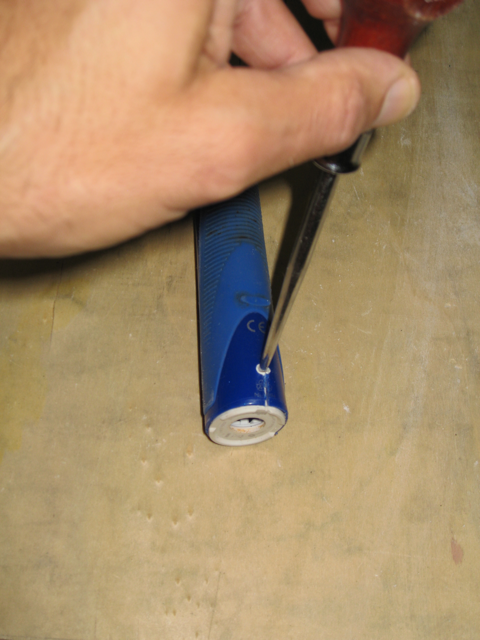
I opened up the battery by pressing on the little white plastic rivet that holds the insides inside. This was a mistake. I could slide the inside out generally, but I had to stretch and tear an electrical cord.

This should have been a sign. By the time I had the toothbrush apart irreversible damage had been done. I think the interior had been glued in place, and removal had to done by force.


Later I got the whole toothbrush apart, and I was pretty pleased. It was going to be pretty ugly, but I was hoping that I'd get it reassembled.

However, it turned out the battery housing was welded to the battery post. Not solder either, actually welded. This was a problem. I was wondering what to do, when I found  . . . .


I found that the replacement battery was actually too large. That is the store sold me the wrong size.  This was hopeless.

At this point, I took pictures of everything and decided to do a blog post.

I also went to the store and bought a new toothbrush.

So I was out 15.99 plus postage for the battery, and had to buy a new one anyway.

I actually bought another Oral-B though. I hope the battery lasts longer.

Sunday, October 24, 2010

Cell Phones Can't Cause Cancer -- Why Did Anyone Think They Could?

How many times have you heard a TV newscaster quoting a scientific source that maybe cell phones cause cancer?  Here and here are examples. Here is one to keep your cell phone out of your bra to avoid cancer. Type "cell phone" cancer into Google News and see for yourself.  The reports often say that studies cannot rule out a risk; or studies suggest a link may exist. Sometimes they talk about vague language in the lawyerly small print of cell phone operating manuals.

Michael Shermer in October's Scientific American wrote that scientifically this can't be true. Why didn't someone point this out before? How many people have been worrying for no reason? Shermer point is that the radiation in cell phones is not great enough to cause a chemical reaction. Longer exposure to low energy radiation does not make a given photon stronger in energy; that is higher in frequency --  there are just more low energy photons. Radiation exposure is simply different than chemical exposure.

Cell phones operate between 380 MHz and 1990 MHz. These waves are in the range of 15 - 80 cm in length, and about as dangerous as old-style TV signals. Waves longer than visible light (about 0.5 mm) are not energetic enough to cause chemical reactions, though they might cause heating, as microwaves (about 1 cm) can cause heating. Visible light interacts with a few cell on our retina in a non-harmful way, and also with fresh photographic film, but the vast majority of objects are unaffected. Sunburn is called by more harmful and energetic ultraviolet light. Cell phone radio waves are at least 30 times less energetic and less harmful.

Obviously cell phones don't make your head warm, or you would feel that. Some people say that the energy from a cell phone can be measurable, but it is just a degree. You get as much heat from the battery discharging or the LED display.

There are curmudgeonly, (generally) old people who think every new thing is dangerous. The frightening talk about cell phone cancer is completely uninformed -- just compulsive worriers babbling.

See the follow-up post from 7-June 2011.

Sunday, October 17, 2010

How Much Does An Artist Make on Itunes UPDATE

----------------Update of my June 2010 post---------------------------

The new iTunes 10 logo. Do you like it?  Seems too generic to me.
The Eminem lawsuit and its settlement made public the funding arrangements that Apple uses with labels.  We see that generally it was the same as I listed in June:  labels get 70%; artists 12% of that ($0.108/song for $1.29 song or $0.083/song for a $0.99 song.)


Music Biz Academy has a few more details.  In its jargon, the $1.29 songs have a "wholesale markup," which seems like a euphemism for "surcharge." The charges for both are the same as above.

They address the producer's 3% share of the label's cut too. Thus the producer and artist together get 15%.


$0.99/song 
    Artist iTunes Royalty (without wholesale markup)  $0.99 download single song price to the consumer less         $0.29 to Appleleft          $0.70 x 12% (net artist net rate) = $0.084 cents per download
    Producer iTunes Royalty (without wholesale markup)  $0.99 download single song price to the consumer less         $0.29 to Appleleft          $0.70 x 3% (producer rate) = $0.021cents per download.


$1.29/song with so-called "wholesale markup"

    Artist iTunes Royalty (with wholesale markup)  $0.99 download single song price to the consumer less         $0.29 to Appleleft          $0.70 x 130% (wholesale markup) x 12% (net artist net rate) = $0.1092 cents per download Producer iTunes Royalty (with wholesale markup)  $0.99 download single song price to the consumer less         $0.29 to Appleleft          $0.70 x 130% (wholesale markup) x 3% (producer rate) = $0.027cents per download.


CDBaby and Tunecore

CDBaby is an independent music distribution company which promises to get music on iTunes, and only take a 9% cut for themselves leaving the artist with $0.63/song @$0.99/song.  The artist is responsible for royalties to the producer or songwriter. Artists pay CDBaby to post an album at $55/album or $9/song, and they need to mail physical CD's to CDBaby. CDBaby also has a site for fans to download albums directly. The artist would need to sell  only 15 copies to be making money. 

A competitive service is Tunecore for which artists need to pay an annual fee of $20/yr + $10/song. Tunecore might be a better deal for prolific artists, and they don't require the old fashioned physical CD. iTunes songs with Tunecore yield the artist $0.69/download (@$0.99/song), and this would be great after selling 43 songs to pay off the fees.


----------------See my June 2010 post---------------------------

Thursday, October 14, 2010

Canada Condemns Bis-Phenol As A Toxic Chemical!!

Fans of Depth of Processing know that I have tracking the condemnation and fall of bis-phenol A for some time. Today, Canada reclassified bis-phenol A as a toxic chemical -- opening it for severe regulation, and possible bans.

The official government Canada Gazette said:

Concern for neurobehavioural effects in newborns and infants was suggested from the neurodevelopmental and behavioural dataset in rodents. Given that available data indicate potential sensitivity to the pregnant woman/fetus and infant, and that animal studies suggest a trend towards heightened susceptibility during stages of development in rodents, it was considered appropriate to apply a precautionary approach when characterizing risk to human health. Therefore, it was concluded that bisphenol A should be considered as a substance that may be entering the environment in a quantity or concentration or under conditions that constitute or may constitute a danger in Canada to human life or health.


... regulations, guidelines or codes of practice to protect the environment and human health. These instruments can be developed for any aspect of the substance’s life cycle from the research and development stage through manufacture, use, storage, transport and ultimate disposal or recycling.


Bis-phenol A is used in a zillion materials, most notably the lining of beverage cans and in polycarbonate plastics. Polycarbonate had been used to make unbreakable kitchenware, but is fading away quickly due to issues with extraction. Polycarbonate is a clear plastic.

I would avoid microwaving in clear plastic containers, and probably not put them in the dishwasher either.


It would seem that the hazard is that bis-phenol A bioaccumulates, so that low dosages can turn into higher dosages in the body. Higher doses trick the body's hormones, and affect development of children especially girls.  It causes precocious sexual development in girls, undersized male parts in boys, and low sperm count in men: at least in high doses. A question is how high is high. 

The next step will be for Health Canada to issue regulations limiting where industry can use bis-phenol A. This will cost millions, but industry should have known this was coming. 


Sunday, October 10, 2010

Rabbit Duck Illusion in Taxidermy


This is a 3-D recreation of a drawing by Joseph Jastrow in 1899. (Sadly I don't know who made the sculpture.

Joseph Jastrow was a professor at my Alma Mater, the University of Wisconsin.  Jastrow used the figure and one of the worlds first randomized experimental trials to show that perception was not the same as stimulus. The original duck-rabbit was in a Munich humor magazine from 1892.

Thursday, October 7, 2010

New Airport Screening by Long Wavelength X-ray and by Microwave

Two weeks ago I was full body scanned as I passed through airport security in Detroit. The operator as in a little closet right next to the unit. It seemed silly to have the poor operator all enclosed in this little showstall sized booth.

There are two kinds of full-body scanners. There are Millimeter Waves and Back-scatter X-ray.

X-Rays are 10 femtometers to 10 nanometers in size. This is 100 times smaller than one millimeter, yet this technology is being called "Long wavelength X-Ray" scanning. The "millimeter waves" don't penetrate very deep, so they are good for picking out stuff on the surface of the body. The waves are 30 to 300 gigahertz, which is 10 - 100 millimeters: as advertised. Since these millimeter waves penetrate, somewhat the collectors need to be spread out, and the result is a 3-D image.

They do penetrate several centimeters though, so this is a little disturbing for medical reasons. These airport scanners have been in experimental use since 2007.

The other technology for full body imaging is "Back-scatter X-ray." A backscatter X-ray is the same as a regular x-ray except that the film is beside the camera rather than on the opposite of the body, that is, it catches the reflected X-rays not the transmitted X-rays that shine through your bod. The X-ray is a stronger kind of radiation, so it is a little more hazardous.  This kind of imaging makes a regular two dimensional image.

I don't think that 3-D images are appreciably better than 2-D images. You can see a gun on either one.

These scanners cost $150,000 each, so they are expensive, but if they last a several years, it is not too bad. The biggest value is making the inspection process less predictable.